Affordable e-bike journeys powered by sunshine
Solar-powered and council subsidised e-bike hire in rural communities, helping people transition to low carbon journeys



Summary
Babergh and Mid Suffolk District Councils have worked with a local delivery partner, Eezybike, to implement solar-powered e-bike hire facilities. Council funding reduces the hire price, making it easier for residents and visitors to undertake their journeys via e-bike, or to try out electric cycling without the upfront purchase cost, encouraging modal shift in the short and longer term. Monitoring data is helping the councils understand use and guide future decisions, as well as report on carbon emissions savings.
“The new Eezybikes at Stowmarket are a great way to explore the area in a healthy and sustainable way. Buying an electric bike is a big investment and by having these e-bikes available at a cheaper hire rate, it gives everyone the opportunity to try them out, see how easy they are to use and decide whether it’s the right option for them.”
Cllr Teresa Davis, Mid Suffolk District Council cabinet member for thriving towns and rural communities
“Residents and visitors alike can book a slot online to explore our districts by e-bike at a subsidised rate – without the upfront cost of buying an e-bike. This helps to increase environmentally friendly travel and means local independent businesses can benefit from cycling tourism. I would encourage everyone to give them a go and experience the health benefits that cycling can bring, along with carbon savings.”
Cllr Helen Davies, cabinet member for climate change, nature recovery and biodiversity at Babergh District Council
The problem
Rural residents and visitors can have limited low carbon travel choices, and the upfront cost of an e-bike can make it hard to transition to electric cycling. The councils wanted to be able to offer affordable e-bike hire to support local journeys and cycling visits, but many of the larger-scale scheme operators did not find the rural villages and market towns of Babergh and Mid Suffolk to be feasible for their operations.
There were also concerns from stakeholders about the risk of bike-littering, so it was important to develop schemes that were of suitable scale and could be tightly controlled. The technicalities of delivering e-bike hire, as opposed to traditional bicycle hire, meant that power (for charging the e-bikes) needed to be considered, but there was a fine balance to strike between investing in civils and groundworks to facilitate this against wanting to keep costs low, in line with the scale the councils were aiming for.
The solution
The councils’ partnership with Eezybike began when efforts were focused toward looking for a way to make e-bike hire work in rural communities and market towns. Eezybike’s compact, flexible approach felt like a better fit for local communities.
We piloted our first scheme together, in 2024, at Needham Lake, a council-owned country park. Following good uptake and positive feedback from this pilot, the councils and Eezybike expanded the provision into Sudbury, Lavenham, and Stowmarket over a two year period.
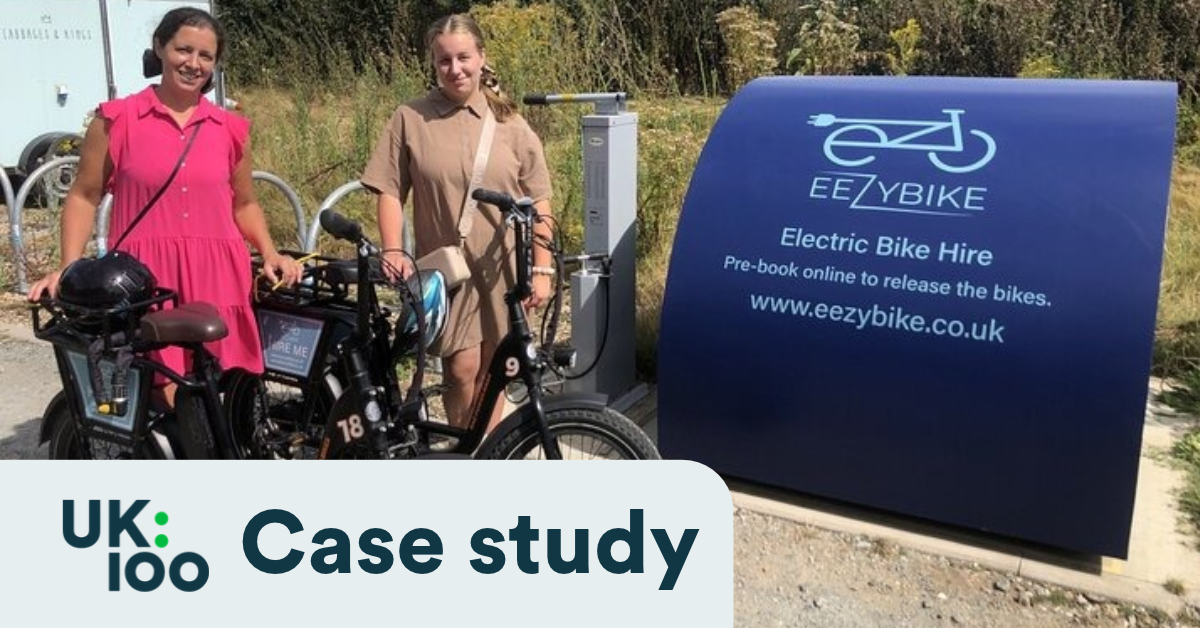
Each scheme centres on an EezyPod, a compact and secure unit that stores and charges two e-bikes, which is the main piece of infrastructure needed to get the scheme up and running. Residents and visitors can then book a half-day or full-day hire of an e-bike online. With council funding keeping prices down, a half-day costs £10 and a full day £18. Riders receive a code to unlock and open the pod and return the bike at the end of their hire.
The introduction of a solar-powered pod was a big step forward: it can operate without a mains connection, opening up more potential sites and making it easier to move a hub if another location proves a better fit.
Eezybike supplies and manages the bikes, pods and booking platform, and shares information on how the schemes are being used. The councils identify sites, coordinate permissions and promotion, and contribute funding to keep hire affordable. Local partners have helped find the right spot for each pod and connect the scheme with their communities.
The impact
The four schemes give residents and visitors a way to try e-bikes without the cost of buying one, and enable healthier and more environmentally sustainable local journeys to local destinations. The schemes have received great feedback from users, which are captured via Trip Advisor and often showcased on social media. One rider said the affordable, accessible hire helped them rebuild fitness and supported their mental and physical wellbeing while managing long-term health conditions. Another had not cycled for around 15 years because of a knee injury; the e-bike helped them return to riding and explore much farther with their dog. Reviewers also regularly praise the easy booking process and the quality and accessibility of the e-bikes. Riders often report that their trip on an Eezybike has made them consider investing in an e-bike of their own, demonstrating the potential for longer term, more frequent modal shift.
Additionally, some more quantative data is being collected. Regular usage monitoring is provided to the councils, which includes the number of e-bike hires per month, the mileage that the e-bikes have been ridden, and an estimation of carbon savings when comparing this to the same number of miles being travelled by car. With this data, it is estimated that – across all four locations – approximately 2.2 tonnes of CO2 has been saved.
The lessons
The first scheme was delivered using an earlier model of the Eezybike ‘pod’, which had to be plugged into a mains electricity source. This increased the implementation costs, and has committed the scheme to fairly permanent location. More recently, solar-powered pods have enabled the schemes to operate without a mains electricity connection, broadening the choice of location for any scheme, and making it possible to trial or move it if a location needs to change, or if uptake isn’t great in a certain place.
We’ve learned that the story doesn’t end when someone hires a bike. Hire numbers and mileage give us a sense of how the schemes are being used, while riders’ comments show what the bikes can make possible: getting back into cycling, making a trip feel more manageable, or exploring further. We’d also like to understand whether someone would otherwise have made their journey by car, which would help us estimate carbon savings more accurately and understand the impact on behaviour change more. However, we want booking to stay quick and easy, so we’re thinking about how we can capture this without turning the process into too much of a customer survey.
The finances
The District Councils contribute between £7,000 to £12,000 to set up each hub in year 1, which is then reduced to an annual cost of between £2,000 to £7,000 for each hub. This enables the hire cost for each e-bike to remain at £10 for half a days hire, and £18 for a full day.
Next steps
The councils will keep building a picture of how people use the schemes by tracking hires, length of hire and estimated distance ridden, alongside rider feedback. Using the same approach across locations will help show what’s working and how use changes over time. The councils will also review the running costs alongside demand and affordability, helping guide how Eezybike is promoted and where it could work well in future.
The councils will continue to explore ways to bring Eezybike to more places, including through funding bids and developer contributions (Section 106). They are also working with Greater Anglia to explore whether bikes could be based at railway stations, making it easier to combine an e-bike ride with train travel.
The councils are sharing what they learn with other authorities, and the schemes were also shortlisted as finalists for two 2026 Modeshift National Travel Awards: Partnership of the Year and Excellence in Active Travel.