Newham launches Tipping Point East – the first Circular Construction Hub of its kind
How Newham is enabling the reuse of construction materials to cut carbon, cut waste and support new homes.


Summary
Newham has opened the UK's first Circular Construction Hub of its kind in the Royal Docks, East London.
The hub reduces construction waste and embodied carbon by enabling the reuse of building materials at scale, while supporting local jobs, green skills and more affordable low-carbon development.
It also demonstrates circular construction in practice through a 100% reclaimed and bio-based office fit-out and provides space for training and community engagement.
“Tipping Point East is about making sure our ambitions for a greener Newham deliver real opportunities for local people. It is about turning climate action into good jobs, practical skills, training and pathways into employment in a growing industry.
By bringing underused land and construction materials back into productive use, we can cut waste, reduce carbon emissions and costs, and support the delivery of much-needed new homes and regeneration across our borough.
But this is about more than changing how we build. We want our residents, schools, colleges and community organisations to get involved, gain hands-on experience and see how tackling the climate crisis can make a real difference to their lives.
Last month, I launched Opportunity Newham, a brand-new approach to ensure local people benefit from investment and new developments. We’re already home to world-class businesses and institutions spanning retail, education, culture, sport and transport. Our existing partners include the likes of Tate & Lyle, London City Airport, West Ham United and the Royal Docks.
I want to be clear: Newham is open for business, and we want to create the conditions for investors to thrive when they work with us.
My ambition is to create 10,000 jobs over the next four years, and Tipping Point East has an important role to play in achieving that. This is what growth with purpose looks like: bringing partners together, championing innovation and creating opportunities that leave a lasting legacy for the people of Newham.”
- Mayor Forhad Hussain
The problem
Construction is one of the biggest sources of waste and emissions in the UK. Construction, demolition and extraction generate 62% of the UK’s total waste (Defra) and 25% of UK emissions are directly attributable to the built environment (UKGBC). Half of the waste produced in Newham comes from the construction industry, while embodied carbon – the emissions released during the extraction, processing and assembly of construction materials – accounts for over 25% of buildings’ total carbon burden, a figure which the Ellen MacArthur Foundation estimates we could reduce by 38% through adopting circular economy principles.
This is relevant to Newham Council because we have a strategic housing target under the Local Plan to deliver 47,600 new homes between 2019/20 and 2028/29. Alongside big ambitions to retrofit social homes to improve energy efficiency, and cut emissions and bills for residents – all of which will require the use of materials.
A 2022 feasibility study commissioned by the Council and run by Arup and Material Cultures, followed by a one-year pilot of a digital materials marketplace, demonstrated that the key barrier to large-scale reuse was not demand for materials but the lack of storage, handling and processing infrastructure for the stage between materials coming out of demolition and being needed for another construction project.
This offered an opportunity for Newham, who as the first local authority in the UK to publish a Just Transition Plan in December 2023, tackles the climate crisis through both environmental and social measures to cut emissions, build resilience and increase equity. These studies gave our council the clear direction it needed to create a Circular Construction Hub in the borough. This has provided the council with an opportunity to be at the forefront of an emerging industry in innovative circular construction practices, creating fair access to new green jobs, skills, and training opportunities for residents.
The solution
Tipping Point East was launched after several years of development in Newham.
The Hub is the first fully integrated logistics and reuse facility to combine industrial-scale material storage, processing, testing, and redistribution within one site. It seeks to fill a critical infrastructure gap in the construction market by serving demolition contractors, developers, and digital materials marketplaces that need reliable local handling and storage space for materials coming out of demolition and being needed for another construction project, which was identified as a key barrier in our research and digital pilot.
The aim is to reduce the cost and uncertainty around reuse, making it easier for the sector to adopt circular practices and demonstrating what is possible to developers and contractors. The hub also includes space for training, volunteering and community activities, giving residents an opportunity to learn green skills relating to material reuse.
A disused building has been refitted with 100% reclaimed and bio-based materials to show how low carbon construction can be delivered in practice. The Royal Docks in the South of the borough was chosen as a location for the hub because of our strategic relationship with the Greater London Authority, land available, and many new developments planned – 36,000 new homes are to be built in the Royal Docks and Beckton area within the coming decade.
The site has initially been secured for meanwhile use to conduct a 5-year pilot, testing how the model can enable large-scale take up of reused materials in Newham, London and beyond.
Newham Council has acted as a convenor and enabler, undertaking feasibility work, securing funding, engaging stakeholders from across our network and working closely with the Greater London Authority to identify, steer and activate a suitable site.
After exploring various options for delivery models, the three organisations who came together to form Tipping Point East – Yes Make, Material Cultures and RESOLVE Collective - submitted a successful proposal to take on the site lease and deliver a Circular Construction Hub. The partnership was selected for its capacity, expertise and ambition to establish and operate the Hub.
Timeline
- 2022: ‘Circular Construction Hub in Newham’ feasibility study conducted by Arup and Material Cultures, funded by UKCRF.
- 2023 – 2025: Development of concept, site location confirmed, funding, partnerships and operators explored in conjunction with the Greater London Authority – resource supported by InnovateUK Net Zero Living Funding.
- Early 2025: Founding partners Yes Make, RESOLVE Collective and Material Cultures began exploring the concept for a circular construction hub and came together to form charitable organisation, Tipping Point East.
- Summer 2025: Agreement in principle signed with the GLA for Tipping Point East to use the site, surveys and design work completed to determine safe activation of the site, lease negotiations.
- October 2025: Licence agreed for material storage and reuse yard to open, enabling early testing of logistics and operational procedures, finalising lease.
- January-May 2026: Lease signed, remedial works and fit-out of office space completed, coordination of site visits, and setting up operational administrative systems. Official launch of site.
Further infrastructure will continue to be developed through later stages of 2026 and beyond, including the establishment of dedicated workshop spaces for fabrication, training and circular construction activities.
Stakeholders
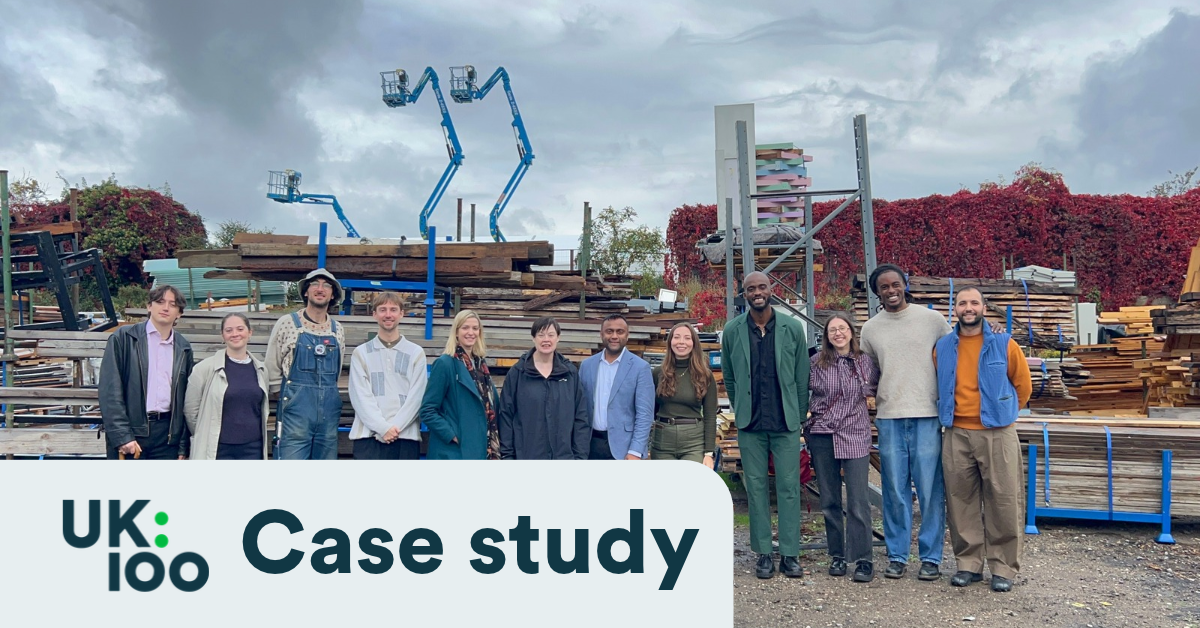
The project is being delivered by Tipping Point East, a charitable organisation formed by founding partners Yes Make, RESOLVE Collective and Material Cultures, with support from the London Borough of Newham and the Royal Docks Team, Greater London Authority.
Tipping Point East holds the lease to the site, manages the overall programme and brings experience in community-led development and reuse.
Yes Make is a material led design and build collective specialised in pushing the limits of socially engaged circular practice, delivering high-quality buildings with, and for, communities in London. Through their projects, they support the social infrastructure that allows communities to thrive. By incorporating circular design – using locally reclaimed materials and fostering community participation – Yes Make creates places that benefit both the environment and the people that use them. Yes Make runs the site operations for the material yard at Tipping Point East, and as well delivered the office build using 100% circular and bio-based materials.
RESOLVE Collective is an interdisciplinary design collective that combines architecture, engineering, technology and art to address social challenges. They have delivered numerous projects, workshops, publications, and talks in the UK and across the world, all of which look toward realising just and equitable visions of change in our built environment. RESOLVE Collective runs the Material Store at Tipping Point East, redistributing materials from cultural institutions.
Material Cultures is an architecture and research practice founded to bring together design, material research and strategic thinking to make meaningful progress towards a regenerative built environment. Material Cultures will develop their MAKE programme on the site, a learning platform that foregrounds practical and accessible construction skills, running education programmes and courses that respond to the polycrisis of climate, biodiversity and housing. Material Cultures designed the office space at Tipping Point East using 100% circular and bio-based materials.
The London Borough of Newham has provided strategic leadership, funding and ensures the project supports the delivery of the borough’s policies, including the Just Transition Plan.
The Greater London Authority and Royal Docks Team are a key strategic partner and have provided land for temporary use to activate the site ahead of long-term redevelopment.
Impact
The Hub is monitoring tonnes of materials reused, embodied carbon savings, waste diverted from disposal, participation in training, and green jobs created to understand its long-term economic, social and environmental benefits.
We estimate the Hub will save up to 900+ tonnes of material by the end of the year. Approx 165,215kg CO2e embodied carbon has already been saved by using reclaimed rather than new materials in the fit-out of the on-site office space.
The hub also has the potential to support the delivery of 36,000 planned homes in the Royal Docks and Beckton Riverside area by supplying materials that lower the carbon impact of construction, and at reduced cost.
The project gives Newham residents access to training and real work experience, strengthens local supply chains and demonstrates that underused sites can be brought back into productive use. It supports a just transition by ensuring the economic and environmental benefits of low-carbon construction are shared across the community.
These workshops will support hands-on education programmes, prototyping and community skills training, expanding the site’s capacity to operate as a circular construction hub and climate futures centre.
During the official week of launch, we welcomed over 600 industry stakeholders on site across six events, activating the market and sharing learnings with others in the sector. This has led to strong early and sustained demand for involvement in the project, including 120 organic email enquiries immediately in the week after the launch including 40 requests for site visits, and a further 150 enquiries in the 6 weeks following – showing that there is momentum in the circular construction space. We have also received regional, national and international interest in the project, including in-person site visits, email exchanges and virtual meetings with representatives from Amsterdam, Delft, Warsaw, Lisbon, Oslo, Stockholm, Madrid and Tampere.
Lessons learned
A key lesson from this project is the importance of developing a robust business case from the outset and testing market demand early. Circular practices are not yet business-as-usual within the construction sector, and can be held back by perceptions of risk, higher upfront costs, and the fact that many approaches have not yet been proven at scale. Undertaking a feasibility study, engaging developers and contractors through existing forums such as our construction forum and place-based sustainability networks in the borough, and piloting concepts (e.g. a digital marketplace) helped demonstrate demand and build confidence among internal colleagues, the industry, as well as potential partners and funders.
Strong partnerships were essential to the success of the project, bringing together organisations with different expertise, networks, and resources. It took time to understand what the Council’s role should be and where we were best placed to reduce emissions from the construction sector, which we decided was as convenors and enablers. While the Council initially conducted feasibility studies, business case development and finding an appropriate site as a space for circular economy activity alongside the Greater London Authority, the long-term success of the hub depended on identifying an operator (Tipping Point East) that could take forward day-to-day delivery with ongoing strategic support from the Council and partners. This collaborative approach helped leverage funding, identify viable operating models, and share risk.
Delivering innovative projects on publicly owned land can take longer than anticipated because of legal, governance and property requirements. A flexible and phased activation approach enabled progress and early engagement with the market while longer-term agreements were finalised.
Leading with the wider co-benefits was also critical. Carbon reduction and waste minimisation are important drivers, but the evident economic and social benefits, such as local job creation, skills development, and engagement with local communities has made this project of interest to a wider audience.
Finances
The hub has been supported through:
- £150,000 from Innovate UK (Net Zero Living: Scale and Embed strand 1)
- £175,000 from Newham Council’s Carbon Offset Fund
Tipping Point East founding partners have invested £54k of their funds to date in securing the lease for the site, as well as £10k to date in costs to fund a dedicated project manager to set up the organisation.
We are currently seeking further funding to expand the site and its operations, to scale the number of materials processed, further reducing emissions in the construction sector.
In terms of the business model, Tipping Point East is a charitable organisation, and activities will be funded by grants, partnerships and revenue.
Next steps
Now that the first building on site has been activated, with an office fit-out using 100% reclaimed and bio-based materials complete, enabling works are beginning on a second building to increase storage and processing capacity. Additional funding and land are being sought to further increase capacity of material reuse and meet demand.
Soon, we will begin a programme to engage local residents, educational institutions including schools, colleges, and universities, and community organisations, via guided site tours and visits, open workshops and volunteer sessions on site. Green skills development is also a key cornerstone of the Hub, with an aim of running reuse-skills sessions focused on dismantling, material sorting, and low-carbon build techniques.
The guiding outcome for the Council’s involvement in the Hub is to reduce emissions from the built environment, and increase the use of circular materials. As such, we will continue to signpost developers, contractors, architects and other stakeholders in the sector to use the Hub, through our sustainability networks, planning service, construction forum and other avenues.
We will also continue to share learnings with industry, local authorities, community groups via networks and working groups we’re a part of, to encourage others to enable, support and set up similar circular economy hubs.