Designing an ambitious community centred Air Quality Action Plan in Westminster
Learn how Westminster City Council designed and developed an Air Quality Action Plan in collaboration with the community it serves, in line with their ambitions to reach the WHO guidelines for air quality by 2040.


Summary
Air pollution is a real and serious threat to public health, the environment and the economy. That’s why Westminster chose an inclusive, community-led approach to tackling it, by designing their Air Quality Action Plan in collaboration with the community it serves.
The problem
Westminster is the political, commercial and cultural heart of London, serving over 200,000 residents and 1.1 million daily visitors. The associated activity, from heating and powering buildings to freight and servicing deliveries and construction generates significant air pollution which is a risk to public health and the environment. Additionally, Westminster is affected by pollution emanating from outside the city boundary, emphasising the need to influence and work collaboratively to tackle sources.
This air pollution is a real and serious threat to public health, the environment and economy and is a social justice issue with our most vulnerable communities being most impacted whilst simultaneously contributing the least to the issue. It is therefore imperative that our response to addressing air pollution has a focus on inclusivity and centred around the needs of our diverse communities.
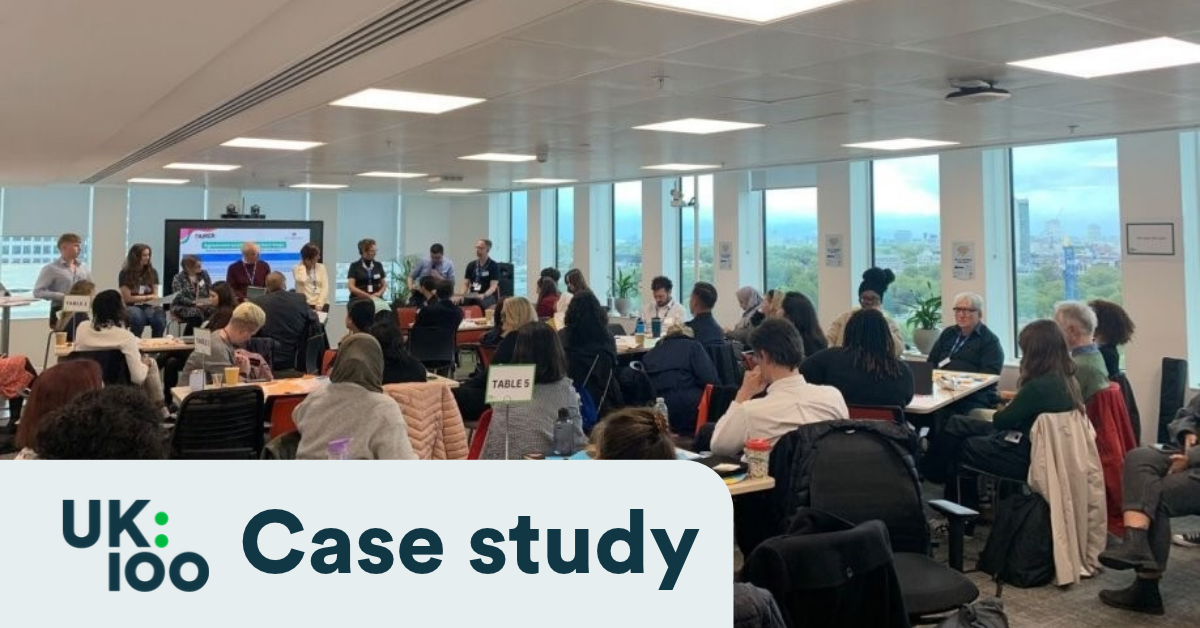
To help tackle the challenge, local government has a core statutory duty to manage air pollution and produce an Air Quality Action Plan (AQAP) every 5 years. Traditionally, the method of drafting air quality action plans has focussed on meeting statutory requirements with a top-down approach. However, our approach was to put communities at the heart of our decision making to shape the City’s future. Translating this approach into the design of the AQAP led us to delivering an air quality ‘Design Day’, where we invited over 50 community members who fairly reflected the make up of the city’s population to work with us on weaving their ideas, wants and needs into the final plan.
By working together, we could ensure everyone informed us of our plans to tackle the air quality challenges in our Borough, and that the final plan delivered real action.
The solution
A baseline study of air quality in Westminster showed that even if we removed all sources of pollution in Westminster, we still wouldn’t meet the WHO guidelines for air quality for all pollutants. This highlighted that shared ownership, collaboration and bold ideas were needed to secure the desired improvements, well beyond the London boundary.
The air quality design day enabled us to gather meaningful and locally relevant ideas, providing an opportunity for our communities to share their insights on what the action plan should look like.
Participation centred around three core themes:
Shape the future: Collaborate with community members, business leaders, and policymakers to identify a vision for cleaner air in Westminster.
- Shape the future: Collaborate with community members, business leaders, and policymakers to identify a vision for cleaner air in Westminster.
- Create impactful solutions: Develop practical and innovative measures to bring that vision to life via the Air Quality Action Plan alongside other passionate individuals.
- Drive positive change: Take responsibility for implementing sector-specific actions, to show a shared commitment to making Westminster cleaner and healthier.
Participants for the design day were selected to best represent the broad cross section of stakeholders from Westminster including our residents, charities, land owners and infrastructure. Over 200 people expressed an interest, of which 50 were selected for participation. In advance of the design day, participants were provided with an information pack for pre-reading, to help ensure that all participants were starting from a ‘level playing field’ of technical information about air quality on the day. Participants were brought together into preassigned groupings, selected to provide a representation of different stakeholders and prior engagement levels in air quality in each grouping. In order to ensure participation from existing underrepresented groups, or those for whom economic barriers may prevent participation, and to recognise the valuable contribution made by them we provided shopping vouchers to participants who were attending in a voluntary capacity (i.e. not as part of their professional day job). The voucher value equated to the London Living Wage hourly rate for their time.
The design day included a number of different activities to reach and engage participants, such as small group discussions, thematic stalls to engage with experts in various areas, the production of rich pictures and presentations.
The pre-consultation draft of the AQAP already reflected priorities raised by stakeholders such as sustainable transport and indoor air quality. The co-design process provided a visible, traceable route into the final AQAP, thus ensuring meaningful engagement
Design day participants were invited to the launch of the Air Quality Action Plan. This was a great opportunity to bring participants back together so they could see the outputs and outcomes of their contributions.
The design day was a step in the finalisation of the AQAP and making it ready for public consultation. However, its purpose goes beyond meeting legal obligations and demonstrates the council’s commitment to drive action towards meeting the WHO guidelines for air quality by 2040 and sets out the delivery roadmap for this. Following production of the AQAP, the GLA provided valuable feedback which we addressed in the final version. As the statutory body for supervising the LLAQM framework (in London), the GLA subsequently reviewed and formally approved the AQAP prior to its adoption.
Timeline
The development of the (AQAP) from the initial scoping of the bespoke air quality model to its official launch took approximately 2 years from June 2023 to June 2025.
This included:
- Developing and agreeing the project scope, project stakeholders, and methodology and associated procurement process, including data sources.
- Researching, planning, organising and delivering the air quality design day with 50 community members.
- Developing the actions in the action plan including iterative refinement based on feedback.
- Public consultation, which ran between December 2025 and January 2026 (7 weeks).
- Review and sign off from the Greater London Authority, in their capacity as the supervising body for the LLAQM framework.
- Final review and sign off from Cabinet Members.
- Launch of the air quality action plan at an event with 60 attendees. Speakers included The Deputy Mayor for London, Mete Coban; the Cabinet Member; the Council’s Director of Environment, a Paediatrician from a local hospital, local landowners and local charity & campaign representatives all spoke during the launch which included a panel discussion. The invitees and attendees were drawn from our local community including residents who participated in the design day.
The delivery of the actions within the AQAP is an ongoing process for the next 5 years. An annual report of progress will be submitted to the GLA in the ‘Annual Status report’ which is published on the Council website.
Stakeholders
The core project group consisted of officers from across the council with specialisms in air quality and policy development, with early engagement from a variety of disciplines, including town planning, digital & innovation, highways and public protection.
For the co-design day, selection was based upon ensuring a wide representation of community members to reflect the breadth of activities required to both reduce emissions from air quality across the City and beyond, but also to ensure that Westminster communities are informed and protected against existing levels of air pollution. For residents, we scored those who expressed an interest in attending through a criteria to ensure this adequately reflected the population we have. We therefore sought to include stakeholders who we both knew would be interested in participating and those stakeholders whose voices are seldom heard (for a variety of reasons). The final invitee list included residents and representatives from businesses, academia, business improvement districts, neighbourhood groups, charities and major landowners, including representatives from Mums for Lungs, Clean Air in London, University of Westminster and Imperial College NHS Healthcare Trust.
During the design day, the full range of air quality themes were provided as discussion points, however there were some topics which we recognised were of more specific interest to some stakeholders. In particular, we identified that sustainable transport was a key theme for the majority of stakeholders ranging from businesses, residents and campaigners; whilst indoor air quality is of key interest to our residents. We therefore sought to ensure that in cases such as indoor air quality, which may only directly impact a small section of stakeholders, that there remained sufficient opportunity to discuss and engage on this, bringing in the key stakeholders that can influence on this.
Impact
The delivery of the AQAP facilitates targeted actions to improve air quality across the City and reduce exposure to poor air quality.
The air quality design day was considered the most successful and impactful element of the development of the air quality action plan. The contributions of the community undoubtedly strengthened and improved not only the quality of the final action plan but will also be felt in its delivery through improved trust and ownership of the action plan.
The AQAP led to a wide-range of initiatives aimed at reducing air pollution.. On indoor air quality, the council were successful in securing a GLA Mayors Air Quality Fund grant to assess the indoor air quality and impact of a low-cost intervention across Westminster homes, with a focus on tackling inequalities. On sustainable transport, the GLA Mayors Air Quality fund grant supported fourteen businesses receiving grant funding to purchase a cargo bike, three shared cargo bikes hosted by three Westminster businesses and a pilot at a local hospital where nine participants borrowed e-bikes to use as part of their work, visiting patients and travelling between sites and the development of a micro logistics hub in the West End.
The benefit of the air quality actions will be borne by all residents, workers and visitors in Westminster – in total over 1 million daily.
Lessons learned
Through the development of the action plan, key lessons we have learnt for future iterations are:
- Gather a clear understanding of data sources held on air pollution levels and key sources of emissions, to assist in better prioritising and targeting resources and interventions.
- Develop a data led emissions reduction trajectory based on the implementation of specific policies.
- Engage and collaborate with stakeholders at an early stage and throughout the process. Doing this meant we were able to utilise our resources more effectively, creating efficiency savings to redirect into interventional work.
- Involve key stakeholders in earlier sessions. as the co-design day was undertaken part way through the development of the action plan and earlier engagement could have better influenced the initial framing, evidence questions and options.
Finances
The development of an Air Quality Action Plan is itself a statutory requirement on the Council and as such is funded through our general revenue budget, supported by public health funding. The entire production of the AQAP project equated to approximately 0.75 officer FTE for 1.5 years, with additional budget utilised for the procurement of the bespoke air quality model (which incurred consultancy costs) and the delivery of the air quality design day which included refreshments and remuneration for residents/unpaid volunteer participants in the form of shopping vouchers equivalent to the London Living Wage for the hours of participation. Those who were attending in a professional capacity as part of their usual day to day job were not remunerated through the use of vouchers. During the design day, Council officers from a diverse range of teams including technical air quality/climate and engagement teams supported through facilitating discussions in the groups and guiding participants throughout the day. This equated to approximately 10 officers throughout the day, who also attended a short online briefing in advance.
Next steps
The vital next steps following the adoption of the AQAP is to maintain relationships and trust with our stakeholders throughout delivery. This began with the launch of the action plan, offering an opportunity to thank participants and share information about our next steps and future engagement. Regular communications and engagement with our communities about delivery actions will take place through working groups, targeted conversations and the Council’s Environment newsletter.
Next steps for indoor air quality include completing the existing projects, analysing the findings and assessing the recommendations. Indoor air quality in other sectors such as commercial cooking establishments are also being examined. The launch of the Council’s Sustainable Transport Strategy in February 2026 provides a clear long term vision and ambitious targets for how people and goods will move around Westminster for the next decade and beyond, including the key pledge of meeting the WHO guidelines for air quality by 2040.
Information about the structure, success and learnings of the design day continue to be shared across the organisation to promote the opportunity of embedding this approach into the design of other action and delivery plans.
If you have any questions about Westminster's community-centred AQAP, please contact Claire Parsons, Principal Environment Officer (Air Quality) at Westminster City Council via cparsons@westminster.gov.uk or airquality@westminster.gov.uk.
You can find out more information about Westminster's AQAP here.