Cambridge City Council’s whole-house net zero retrofit pilot
Learn how Cambridge City Council used a 48-home pilot to test whole-house net zero retrofit and apply the lessons to its wider housing retrofit programmes


Summary
Cambridge City Council delivered a whole-house retrofit pilot across 48 council homes on two streets, testing how existing homes could be significantly improved through a combination of fabric measures, low-carbon heating, ventilation and renewable technologies.
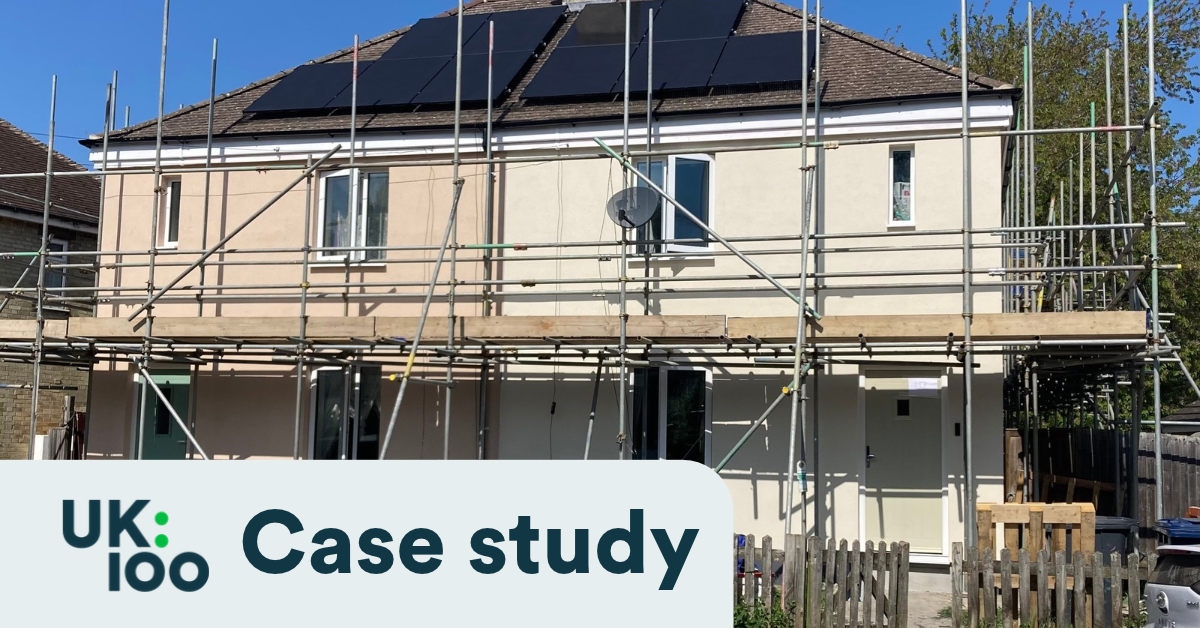
The pilot included a range of measures, including external wall insulation, upgraded windows and doors, roof and floor insulation, air source heat pumps, mechanical ventilation with heat recovery (MVHR), solar PV and heat storage. This created an opportunity to assess how multiple technologies perform together in occupied homes.
As well as delivering improvements to the thermal performance of the homes, the project has supported Cambridge City Council to understand best practice in retrofit delivery, including engagement with residents and other stakeholders, and this experience is now informing future retrofit delivery across the council.
“This pilot was designed to push boundaries and explore what can be achieved through whole house retrofit. Alongside the improvements to residents’ homes, it has given us valuable insight into the practical challenges and opportunities involved in delivering this work. “We’re using that experience to shape future investment in hundreds more council homes across Cambridge, ensuring our retrofit programmes are practical, effective and built around residents’ needs. Our objectives are to help our residents to reduce energy consumption and lower their household bills whilst creating healthier more comfortable homes.” – Cllr Rosy Moore, Cabinet member for climate action and environment, Cambridge City Council
The problem
Retrofitting homes delivers a range of benefits, from reducing carbon emissions and lowering energy bills, to improving residents’ health and wellbeing. With residential buildings accounting for around 20% of the UK’s greenhouse gas emissions, retrofit measures can also help create warmer homes in winter and cooler homes in summer, improving comfort and quality of life for residents.
Cambridge City Council has a significant stock of over 7,000 existing council homes, many of which require multiple improvements to the building fabric to lower energy demand and introduce low carbon heating and ventilation systems. To ensure retrofit measures were as effective as possible, it was necessary to view these upgrades collectively, undertaking a whole-house retrofit approach, rather than viewing each measure in isolation.
The council recognised that achieving deep retrofit was not simply a technical challenge. Understanding the practical impact of the works on residents, who remained in their homes throughout the project, alongside the support and engagement they would need during and after the works, was central to the successful design, construction, commissioning and maintenance of a whole house retrofit. The council therefore undertook a pilot to build real-world experience and evidence, helping to inform a wider rollout of whole-house retrofit across the city.
The solution
Cambridge City Council invited residents within a neighbourhood to voluntarily undergo whole house retrofit as part of the pilot. The council selected eligible households with a shared 1930s solid-wall archetype, to develop a consistent and more efficient design and delivery approach across the pilot, rather than multiple differing packages of interventions.
The geographic proximity of the homes allowed the council to understand the collective neighbourhood impact of such a scheme, performing extensive retrofit measures on multiple houses in the same streets.
48 households at Ross Street and Coldham’s Grove agreed to take part in the pilot. The voluntary nature of their participation was crucial: the extent of the interventions, delivered whilst residents occupied their homes, needed a deep commitment from tenants, as well as from the council. Those occupying one-bed flats were the exception in that they were unable to remain in their homes whilst the retrofit measures were installed.
The city council’s housing scrutiny committee approved the project budget in January 2022, with planning permission granted in September 2023, and building control approval received in December 2023. The retrofit measures were delivered from March 2024 - March 2026.
The range of measures delivered to the 48 homes included:
- External wall insulation
- Triple-glazed windows and upgraded doors
- Underfloor and roof/rafter insulation
- Air source heat pumps
- Mechanical ventilation with heat recovery (MVHR)
- Solar PV
- Hot water storage
Whilst the technical delivery spanned years, delivery of the pilot is ongoing, as residents need support as they adapt to new technologies and changes - and the council recognises that this is an integral part of successful deep retrofit. This has included the council offering demonstrations of new heating systems, with 5 residents taking up a further individual heating system demonstration in October 2025, and a support event hosted in January 2026. National Energy Action is providing ongoing independent energy advice for those households taking part in the pilot. Monitoring and evaluation also continue, to understand the impacts of the retrofit measures in the real world, rather than relying on modelling.
Stakeholders
The council engaged a range of stakeholders to deliver the pilot scheme. The project included architectural design, contract administration, retrofit design and retrofit coordination, alongside specialist technical input for the different measures and building services.
Other stakeholders included:
- ECD Architects: architect, contract administrator and retrofit designer.
- Keegans: retrofit coordinator.
- Axis Europe PLC: the main contractor responsible for construction delivery, coordinating the installation of the different measures and specialist subcontractors.
- A range of multidisciplinary specialist contractors: needed for elements including external wall insulation, low-carbon heating, ventilation, solar PV and other building services.
- Greengauge: technical heating design, monitoring and analysis, supporting the council to understand post-retrofit performance and identify opportunities for optimisation.
- National Energy Action (NEA): independent advice and support to residents, complementing the technical support available through the project team.
Impact
48 homes in Cambridge have received help from the whole-house retrofit pilot, through a range of energy efficiency improvements and the installation of new technologies for low carbon heating and renewable energy.
The council’s monitoring and evaluation have shown that these interventions have reduced heat loss from homes by between 30%-70%, laying the foundations for the more effective and efficient use of low carbon heating technologies, and reducing homes’ energy demand.
Cambridge City Council anticipates a range of co-benefits for households involved in the pilot, including the potential for lower bills, although this is impacted by a range of external factors including energy use and energy tariffs. The council is also in the process of understanding the impact on energy performance certificates (EPCs) as a result of the scheme.
For Cambridge City Council, the pilot is providing real-world data on the combined and interacting impacts of building fabric, low carbon heating, ventilation, and renewable technologies. As the council plans further retrofit interventions, this data is being used to inform investment decisions.
Lessons learned
The pilot was built around the need to treat deep retrofit as a whole-house system, understanding the combined effects of, and interactions between, a variety of interventions on the home overall, rather than viewing measures in isolation. Whilst this approach has proved effective, the council does not underestimate the coordination challenges posed by such extensive and complex projects. Ensuring sufficient capacity to manage multiple contractors, resident engagement and liaison, and to develop a clear sequencing for the programme is vital to minimise added unnecessary disruption.
Resident engagement has been an integral part of the pilot. Cambridge City Council has recognised that resident experience is a core measure of success, not just technical performance, and that communication, minimising disruption, and resident support and confidence following the installation of new technologies are all key indicators of success. It was important to build resident support into the programme from the start, rather than introducing it as a response to issues arising, and to try to plan the installation of new technologies to minimise disruption and thus maintain and strengthen support. For example, by considering the season during which new heating systems were introduced and avoiding the colder seasons when those systems are not in constant use. Equally, being transparent and honest in communications with residents is also key; Cambridge City Council has been cautious not to over-promise benefits of the retrofit scheme, including financial savings to households, given the number of external factors such as energy tariffs and the ways in which residents use their homes which can influence bills.
Strong monitoring and evaluation processes, during and following completion of the works, have proved useful in technical performance, resident engagement, and learnings for future retrofit projects in the city. Monitoring the actual effects of the retrofit measures, rather than relying on modelling, has allowed Cambridge City Council to understand the effectiveness of the interventions in real-world use cases, informing future projects, and allowing for post-installation optimisation to be undertaken in response to how residents use their homes.
The pilot has also supported the council to identify unforeseen challenges to inform future work. For example, the selection of eligible homes due to their common 1930s solid wall archetype aimed to maximise efficiencies in design and delivery, but in practice a range of variations were necessary due to differences in each home, and the varying needs and circumstances of residents.
In this pilot scheme, the depth of the interventions was extensive, demonstrating what is technically possible with the interaction of a wide range of retrofit measures. However, it is important to match the depth of intervention to the objectives of the programme at hand: the pilot has generated real-world data on the impacts of the deep retrofit process on a neighbourhood scale, as well as the effects of the work on households. When considering future projects, such a depth of intervention may not be necessary to achieve more targeted technical objectives.
Finances
Cambridge City Council’s housing scrutiny committee approved the project budget in January 2022. The estimated cost for each property was £117,799, reflecting the extent of the fabric, low carbon heating, ventilation, and renewable technology work being undertaken in this deep retrofit scheme. The scheme was funded by the council through its ring-fenced housing budget, the Housing Revenue Account.
Next steps
As well as continuing provision of resident support, independent energy advice, and post-installation optimisations for the 48 homes in the pilot, Cambridge City Council is already using the learnings from the project to inform a larger-scale retrofit scheme affecting 370 council-owned homes. These improvements, funded through the Government Social Housing Fund, and supported by the Councils ring fenced budget, the Housing Revenue Account, are being shaped by the experience of delivering the original pilot project.
The council is also continuing to share its experiences and lessons learnt from the pilot project with other local authorities, including through networks such as UK100, to support others as they embark on ambitious retrofit schemes.